Biomod/2013/Todai/Result: Difference between revisions
Kenta Koyama (talk | contribs) No edit summary |
Kenta Koyama (talk | contribs) No edit summary |
||
| Line 224: | Line 224: | ||
<!--editting--> | <!--editting--> | ||
<h2 class="small-title"><a name="STEP2"> STEP 2: Penetration into the membrane</a></h2> | |||
<article> | <article> | ||
| Line 295: | Line 295: | ||
<article> | <article> | ||
<h3><a name="Preparation_of_GUVs" | <h3><a name="Preparation_of_GUVs">2) Preparation of GUVs</a></h3> | ||
<!--Method--> | <!--Method--> | ||
<div class="zairyou-heading">[Method]</div> | <div class="zairyou-heading">[Method]</div> | ||
| Line 442: | Line 442: | ||
<article> | <article> | ||
<h2 class="small-title"><a name="STEP4" | <h2 class="small-title"><a name="STEP4"> STEP 4: Oligomerization in solution</a></h2> | ||
<!--◆◆4.1 Oligomerization by streptavidin-biotin complex◆◆--> | <!--◆◆4.1 Oligomerization by streptavidin-biotin complex◆◆--> | ||
Revision as of 01:51, 27 October 2013
<html> <head> <meta name="viewport" content="width=1200">
<style>
</style> </head>
<body>
<figure>
<img src="http://openwetware.org/images/9/9c/Logo-OCKver.png" width=730px height=128px>
</figure>
 <a href="#TOP">
   <figure>
     <img src="http://openwetware.org/images/b/b1/Return-top-0828new.png" width:60px height:60px>
   </figure>
 </a>
</body> </html>
<html> <head> <title>Result-Todai nanORFEVRE-</title> <style>
figure.figure-left {
 position:relative;
 left:-35px;
 }
.res-conclusion {
 font-size:120%;
 font-weight:bolder;
 color:blue;
 position:relative;
 left:30px;
 margin-top:10px;
 }
</style>
</head>
<body>
<a name="Result"> Result</a>
<a name="Contents"> Contents</a>
<a href="#STEP1">STEP 1: DNA strands assemble to form designed structures</a>
- <a href="#Optimize_the_condition_to_assemble_OCK">1)Optimize the condition to assemble OCK</a>
- <a href="#Conformation_of_the_3D_structure_of_OCK_by_TEM">2)TEM imaging of the 3D structure of OCK</a>
<a href="#STEP2">STEP 2: Penetration into the membrane</a>
- <a href="#Flotation_assay">1)Flotation asssay</a>
- <a href="#Preparation_of_GUVs">2)Preparation of GUVs</a>
<a href="#STEP3">STEP 3: Recognition of cancer-specific proteins</a>
<a href="#STEP4">STEP 4: Oligomerization in solution</a>
- <a href="#Oligomerization_by_streptavidin-biotin_complex">1)Oligomerization by streptavidin-biotin complex</a>
- <a href="#Tem_imaging_of_OCK_dimers_by_streptavidin-biotin_complex">2)TEM imaging of OCK dimers connected by streptavidin-biotin interaction</a>
- <a href="#Oligomerization_by_Click_reaction">3)Oligomerization by Click reaction</a>
<a name="Oligomeric_Cell_Killer_(OCK)"> Oligomeric Cell Killer (OCK)</a>
<article>
<a name="STEP1"> STEP 1: DNA strands assemble to form designed structures</a>
<a name ="Optimize_the_condition_to_assemble_OCK"></a>1)Optimize the condition to assemble OCK
      <figure class="figure-left">
        <img style="float:left; margin:0;margin-right:-10px;margin-bottom:10px;"
        src="http://openwetware.org/images/1/1e/OCKnaname-Todai.png" width="200px" height="200px" >
      </figure>
The DNA nanostructure, <a target="_bramk" href="http://openwetware.org/wiki/Biomod/2013/Todai/Design#Oligomeric_Cell_Killer " style="color:#e00000"> "Oligomeric Cell Killer" </a> , was designed to achieve our goal(--><a href="http://openwetware.org/wiki/Biomod/2013/Todai/Project">Project</a>).
To know the optimum condition of the structure assembly, we did experiments in three conditions as follows.
- At different concentration of MgCl2
- At different incubate temperature
- At different length of incubate time
       (<a target="_blank" href="http://openwetware.org/wiki/Biomod/2013/Todai/Experiment#Protocols" style="color:#e00000;">
       protocols
       </a>
       )
Optimum concentration of MgCl2
<figure>
        <img src="http://openwetware.org/images/a/af/OOCK_Optimize_MgConc.png" width=640px height=360px>
           <figcaption> Agarose-gel electrophoresis to research the optimum concentration of MgCl2
</figcaption>
</figure>
Fast-migrating species upon agarose-gel electrophoresis was yielded at 10~20mM MgCl2 condition. At higher MgCl2 concntration, a sub-band, which might be a dimer, appeared.
--->> Optimum concentration of MgCl2: 10mM
Optimum incubate temparature
<figure>
          <img src="http://openwetware.org/images/9/95/OOCK_Optimize_Temp-Todai.png" width=640px height=360px >
          <figcaption>
          Agarose-gel electrophoresis to research the optimum temperature
          </figcaption>
</figure>
Fast-migrating species upon agarose-gel electrophoresis was yielded at 52.0 °C.
--->> Optimum temparature : 52.0 °C
To decide optimum length of incubate time
<figure>
          <img src="http://openwetware.org/images/9/94/OOCK_Optimize_Time-Todai.png" width=640px height=360px >
          <figcaption>
          Agarose-gel electrophoresis to research the optimum time
          </figcaption>
</figure>
The band for 3h is fast migrated and sharp.
--->> Optimum incubate time : 3h
<a name="Conformation_of_the_3D_structure_of_OCK_by_TEM"></a>2)Conformation of the 3D structure of OCK by TEM
Gel electro phoresis cannot visualize the 3D structure of OCK, so it was confirmed by Transmission electron microscopy (TEM) (<a target="_blank" href="http://openwetware.org/wiki/Biomod/2013/Todai/Experiment#Protocols" style="color:#e00000;"> protocols </a> )
</article>
TEM imaging of OCK
<figure>
        <img src="http://openwetware.org/images/e/ea/Monomer-Todai.png" width=480px height=360px>
           <figcaption> TEM image of OCK
           Three monomers of OCK were observed in this figure.

           </figcaption>
</figure>
TEM images confirm that our OCK has two domains. Comparing the observed structure to our design, one domain match the shape and size to plane-like domain. And the other domain matches to stick-like domain. Furthermore, in close watching the images, DNA well, which exists one side of plane-like domain, could be detected.
</article>
<a name="STEP2"> STEP 2: Penetration into the membrane</a>
<article>
<a name=" Flotation_assay"></a>1) Flotation assay
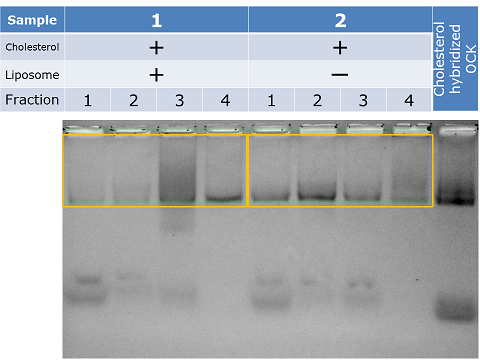
OCK was designed to penetrate lipid bilayer. However, it is difficult to conclude the penetration of OCK. Therefore, we first did flotation assay to detect the interaction of OCK with lipid. (<a target="_blank" href="http://openwetware.org/wiki/Biomod/2013/Todai/Experiment#Protocols" style="color:#e00000;"> protocols </a> )
<figure>
        <img src="http://openwetware.org/images/c/ca/Todai_result_step2_fluolescence.JPG" width=450px height=350px>
           <figcaption> The fluorescence intensity of NIL (in liposome) in each fraction

           The result of fluorescence spectrophotometer (JASCO, FP-6500) showed that liposome distributed mostly in fraction 3(lower layer).
           </figcaption>
      </figure>
          <figure>
        <img src="http://openwetware.org/images/f/fe/FlotationOCK12gel-Todai.png" width=480px height=360px>
           <figcaption> 1% Agarose gel electro phoresis of each fraction in sample 1, 2
           </figcaption>
      </figure>
          <figure>
        <img src="http://openwetware.org/images/0/0d/FlotationOCK34gel-Todai.png" width=480px height=360px>
           <figcaption> 1% Agarose gel electro phoresis of each fraction in sample 3, 4
           </figcaption>
      </figure>
          <figure>
<img src="http://openwetware.org/images/f/ff/450px_FloatingOCKprofile-Todai.jpg" width=450px height=300px>
</figure>
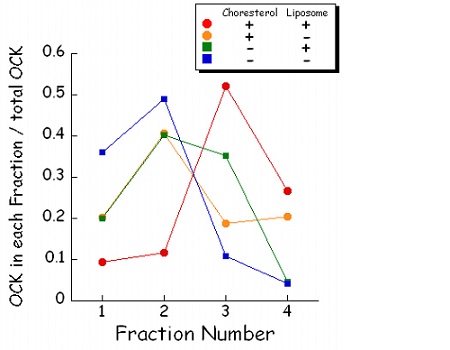
With the condition of cholesterol +/ liposome+, the peak fraction was No.3, which coinced with peak fraction of liposome. In contrast, lacking of cholesterol or liposome, OCK exist mainly in fraction No.2. As the peak fraction of OCK shifted from fraction No.2 to No.3, with the attachment of cholesterol and existence of liposome, we concluded that OCK stack in liposome.
--> OCK stack in liposome.
</article>
<article>
<a name="Preparation_of_GUVs">2) Preparation of GUVs</a>
GUV, Giant Unilamellar Vesicle, was prepared to visualize the sticking of OCK in membrane. The comparation between the fluorescence of OCK (Cy5) and GUV(NIL, Nile Red) was expected to suggest the sticking. (<a target="_blank" href="http://openwetware.org/wiki/Biomod/2013/Todai/Experiment#Protocols" style="color:#e00000;"> protocols </a> )
<figure>
        <img src="http://openwetware.org/images/b/be/GUVconfocal_scale-Todai.png" width=450px height=350px>
           <figcaption> The ratios of OCK in each fraction analyzed by the density of band.
           </figcaption>
</figure>
GUVs were observed with confocal laser scanning microscope (Carl Zeiss, LSM 5 Exciter). As the tracer of GUVs, 0.1 mol% Nile Red (Ex 553 nm, Em 637 nm) was used. About 10 um of GUVs were observed.
--> OCK stack in liposome.
</article>
<article>
<a name="STEP3"> STEP3: Subunits recognize cancer-specific proteins. </a>
<a name=""></a>
We confirmed the integration of aptamer attached strands (aptamer strands) into rectangle DNA origami tile (rect-tile). (<a target="_blank" href="http://openwetware.org/wiki/Biomod/2013/Todai/Experiment#Protocols" style="color:#e00000;"> protocols </a> )
</article>
<figure>
        <img src="http://openwetware.org/images/e/e4/Tile_insertion-Todai.png" width=480px height=360px>
           <figcaption>
</figcaption>
</figure>
We confirmed the integration of aptamer attached strands (aptamer strands) into rectangle DNA origami tile (rect-tile).
<figure>
        <img src="http://openwetware.org/images/f/f5/Figure9_10-Todai.png" width=480px height=270px>
           <figcaption>
</figcaption>
</figure>
We confirmed the responsibility of aptamer sequence embedded in rect-tile (shown above). The position of Cy5-PDGF band coincided with that of DNA tile, showing that the aptamers work also on rect-tile. Furthermore, the linker length between aptamer sequence and staple sequence, the latter staple sequence is embedded into rect-tile, does not affect the binding ability of aptamer to PDGF.
<tbody> </tbody>
       <figure>
         <img src="http://openwetware.org/images/3/30/Figure11_12-Todai.png" width="320px" height="240px">
</figure> |
       <figure  style="position:relative;left:-50px;">
         <img src="http://openwetware.org/images/9/93/SA-tile-graph-Todai.png" width="320px" height="192px">
</figure> |
We confirmed the blocking capability of our lock system for streptavidin binding (left figure, the image of gel electrophoresis). Our lock system consists of two strands: biotin attached strands (biotin strands) and aptamer attached strands (aptamer strands). These two strands hybridize each other in inactive form and hide biotin moiety from the streptavidin by steric hindrance effect. We confirmed this blocking capability by mixing Cy3 labeled streptavidin with lock system embedded rect-tile. Dada indicates that the slight blocking capability upon shorten the polyT linker between aptamer sequence and staple sequence. Recently, we tried other sequence and have better results, which may presented in the Jamboree in Boston. Next, we optimize the embedding condition of our lock system into rect-tile. This time full length of biotin strands were used instead of truncated ones used in Figure 11 to 13. Data indicate that the integrate efficiency of both biotin strands and aptamer strands into rect-tile is independent on the incubate temperature. We improve our lock system everyday. Don't miss our presentation in Jaboree in Boston !
<article>
<a name="STEP4"> STEP 4: Oligomerization in solution</a>
<a name="Oligomerization_by_streptavidin-biotin_complex"></a>1) Oligomerization by streptavidin-biotin complex
Biotins are equipped to OCK for oligomerization. The experiment which confirmed that streptavidins induced oligomeriation. (<a target="_blank" href="http://openwetware.org/wiki/Biomod/2013/Todai/Experiment#Protocols" style="color:#e00000;"> protocols </a> )
</article>
Streptavidins induced oligomerization
<figure>
<img src="http://openwetware.org/images/5/5b/Streptavidin_dimer-Todai.png" width=600px height=450px>
<figcaption>The mixing ratio of streptavidin to OCK was equal to 5:3, which means the mixing ratio of streptavidin to biotin was equal to 5:6 in the condition (L+R).</figcaption>
      </figure>
    </article>

    <article>
<a name="Tem_imaging_of_OCK_dimers_by_streptavidin-biotin_complex"></a>2) TEM imaging of OCK dimers connected by streptavidin-biotin interaction
Dimers of OCKs were also imaged by TEM to confirm the bands observed in the experiment 3.1) originated from the dimers. (<a target="_blank" href="http://openwetware.org/wiki/Biomod/2013/Todai/Experiment#Protocols" style="color:#e00000;"> protocols </a> )
</article>
       <figure>
         <img src="http://openwetware.org/images/c/c1/Dimerv2-Todai.png" width="300px" height="300px" >
       </figure>
|
       <figure>
         <img src="http://openwetware.org/images/5/53/Dimer_2v2-Todai.png" width="300px" height="300px" >
       </figure>
|
Dimers of OCKs were observed in this experiment and two of them were shown above.
-->The dimerization by streptavidin-biotin complex was confirmed.
<article>
<a name="Oligomerization_by_Click_reaction"></a>3) Oligomerization by Click reaction
Azide and alkyne, which function as a reactive group of click reaction, are also equiped to OCK. It demands Cu+ as catalyst, but too high concentration of Cu+ (cation) might denaturate OCK like Mg2+. Therefore, we optimized the concentration of Cu+ to OCK first, and then the optimum Cu+ concentration to click reaction was investigated. (<a target="_blank" href="http://openwetware.org/wiki/Biomod/2013/Todai/Experiment#Protocols" style="color:#e00000;"> protocols </a> )
a) Optimum concentration of CuSO4 to OCK
<figure>
<img src="http://openwetware.org/images/5/5e/CuAlive-Todai.png" width=600px height=450px>
</figure>
-->Optimum concentration of CuSO4: 625 uM or less
b) Optimum concentration of CuSO4 to click reaction
<figure>
<img src="http://openwetware.org/images/9/94/ClickResult-Todai.png" width=600px height=450px>
</figure>
Product of click reaction appeared over 375 uM CuSO4 concentration. Combining with the stability data, we decided to use 625 uM CuSO4 condition.
--> Optimum concentration of CuSO4: 625 uM
</article>
<footer style="position:relative;left:400px"> Copyright © Todai nanORFEVRE, all rights reserved. </footer>
</body> </html>