Biomod/2013/Todai/Experiment: Difference between revisions
Kenta Koyama (talk | contribs) No edit summary |
Kenta Koyama (talk | contribs) No edit summary |
||
| Line 347: | Line 347: | ||
<!--scaffold+staple+cholesterol--> | <!--scaffold+staple+cholesterol--> | ||
<article> | <article> | ||
< | <h2 class="PS_title"> | ||
<a name="Assembling_of_DNA structure (scaffold+staple+cholesterol)">1.Assembly of DNA structure (scaffold+staple)<sup>[2]</sup></a> | <a name="Assembling_of_DNA structure (scaffold+staple+cholesterol)">1.Assembly of DNA structure (scaffold+staple)<sup>[2]</sup></a> | ||
</ | </h2> | ||
<!--Reagent--> | <!--Reagent--> | ||
Revision as of 06:43, 19 September 2013
<html> <head> <meta name="viewport" content="width=1200">
<style>
</style> </head>
<body>
<figure>
<img src="http://openwetware.org/images/9/9c/Logo-OCKver.png" width=730px height=128px>
</figure>
 <a href="#TOP">
   <figure>
     <img src="http://openwetware.org/images/b/b1/Return-top-0828new.png" width:60px height:60px>
   </figure>
 </a>
</body> </html>
<html> <head> <title>Experiment-Todai nanORFEVRE-</title> <style>
- Explist ul {
 position:relative;
 left: 20px;
 }
.mokuji {
 font-size: 150%;
 line-height: 1.6;
 display: block;
 }
.mini-title a {
 font-size :130%;
 font-weight:bolder;
 display: block;
 text-decoration: none;
 color: #000000;
 position: relative;
 left:25px;
 line-height: 1.5;
 margin-bottom: 10px;
 }
table,th,td {
 border: solid 1px black;
 }
table {
 border-collapse: collapse;
 position:relative;
 left:45px;
 }
th {
 width: 200px;
 background-color: #FFF2E4;
 font-weight: lighter;
 padding: 5px 10px 5px 10px
 }
td {
 width: 50px;
 background-color: #f7f7f7;
 padding: 5px 5px 5px 10px
 }
.procedure-list {
 width:650px;
 font-size: 110%;
 position: relative;
 left: 45px;
 }
.Contents-list {
 width:650px;
 font-size: 100%;
 position: relative;
 }
.procedure-list li {
 list-style:none;
 list-style-type: decimal;
 }
 .Contents-list li {
 list-style:none;
 list-style-type: decimal;
 }
.preparation {
 font-size:110%;
 position:relative;
 left:60px;
 width:650px;
 text-indent:1em;
 }
.PS_title a{
 color:black;
 text-decoration:none;
 }
.Contents-list li a {
 color:black;
 text-decoration:none;
 }
</style> </head>
<body>
<a name="Experiment"> Experiment</a>
- <a href="#Contents">Contents</a>
- <a href="#PilotStudy">Pilot Study</a>
- <a href="#Protocols">Protocols</a>
<article>
<a name="Contents"> Contents</a>
<article>
-
<a name="#Assembling_of_DNA_structure">
Assembly of DNA nanostructure
</a>
-->(See <a href="http://openwetware.org/wiki/Biomod/2013/Todai/Result" style="color:#E00000">Result</a>)
Optimize the assembly condition of the DNA nanostructure,"Cylinder in barrel" - <a name="#flotation_assay">Flotation assay</a>
- <a href ="#Preparation_of_liposome">Preparation of liposome</a>
Making of liposome for floatation assay -
<a href ="#Flotation_assay_of_liposome_and_DNA_origami">
Floatation assay of liposome and DNA origami
</a>
Assay to check the penetration of DNA origami
- <a href ="#Preparation_of_liposome">Preparation of liposome</a>
-
<a href ="#Comparision_of_dimerization">
Comparision of dimerization method
</a>
-
<a href ="#Click_reaction_via_(3+2)_cycloaddition">
Click reaction via (3+2) cycloaddition
</a>
Optimize the reaction condition for click chemistry
- <a href ="#Azobenzene">Azobenzene</a>
- <a href ="#Synthesis_of_Tube(Research_for_azobenzene)">Synthesis of tube</a>
Optimize the assembly condition pf the DNA origami tube to be equipped with azobenzene
- <a href ="#Synthesis_of_Motif(Research_for_azobenzene)">Synthesis of tube</a>
Optimize the assembly condition of the DNA motif to be equipped with azobenzene
- <a href ="#Synthesis_of_Tube(Research_for_azobenzene)">Synthesis of tube</a>
-
<a href ="#Click_reaction_via_(3+2)_cycloaddition">
Click reaction via (3+2) cycloaddition
</a>
 </article>
</article>
<article>
<a name="PilotStudy"> Pilot Study</a>
<article>
<a name="Assembling_of_DNA_structure"> 1.Assembly of DNA nanostructure</a>
The assembly of DNA structure is explained in the
<a href="http://openwetware.org/wiki/Biomod/2013/Todai/Result" style="color:#e00000">Result page</a>.
<a name="flotation_assay"> 2.Flotation assay</a>
<a name="Preparation_of_liposome">2-1. Preparation of liposome</a>
<figure>
        <img src="http://openwetware.org/images/b/b5/640px_liposomeDLS-Todai.png" width=640px height=360px >
<figcaption> The result of DLS
     </figcaption>
</figure>
In flotation assay, uniformly-sized liposomes are required because liposomes should have same buoyancy. Moreover, liposomes must have enough radiuses (about 100nm in radius) to float in sucrose buffer. Using Extruder device(Avanti), we prepared liposome of 120nm in radius.
</article>
<article>
      <a name="Flotation_assay_of_liposome_and_DNA_origami">2-2. Floatation assay of liposome and DNA origami</a>
      <figure>
        <img src="http://openwetware.org/images/1/1d/640pxflotationassay-Todai.jpg" width=300px height=300px >
<figcaption> Result of agarose gel electrophoresis of the sample of flotation assay

The result of 1% agarose gel electrophoresis(100V,30min). In this measurement, the fluorescence of Cy5, which is
integrated into DNA origami(Rect tile[1]) ,is observed. Fraction1 is the liquid in the top layer, and fraction 5 is in the bottom layer. Fraction 6 is the sample retrieved from precipitation. DNA origami solely was also loaded on the extreme right lane. </figcaption>
      </figure>
      <figure>
        <img src="http://openwetware.org/images/0/0d/300pxNILGraph-Todai.PNG" width=350px height=350px >
<figcaption> Fluorescence intensity of the samples of flotation assay(DNA Rect tile +liposome)
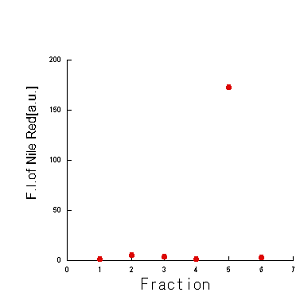
Although the size of liposome might change during the flotation assay(data not shown), the intensity of the fluorescence of NIL(Nile Red, ex 500nm, em 550~700nm ) suggests the amount of lipid membrane,liposome. The fluorescence spectrum of water was subtracted as background
</figcaption>
</figure>
To confirm the flotation assay, mixed tiles(DNA origami) and liposomes were assayed. Five samples (fraction 1,2,...,5, from the top) were retrieved from supermetant liquid and a sample(fraction 6) from precipitation by the addition of buffer used in assay. When the sample, tile mixed with liposomes, were assayed, tiles were observed in the top layer. The distribution of liposomes is observed by the fluorescence of NIL(Nile Red).
</article>
<a name="Comparision_of_dimerization">3. Comparision of dimerization method</a>
<article>
      <a name="Click_reaction_via_(3+2)_cycloaddition">
      3-1. Click reaction via (3+2) cycloaddition[4]
      </a>
<figure>
        <img src="http://openwetware.org/images/a/ab/450pxclick0828-Todai.jpg" width=480px height=360px >
<figcaption> Result of urea gel electrophoresis of the sample of click reaction
</figcaption>
</figure>
Copper(Ⅰ) catalyzed click reaction was used to dimerize of oligo DNA(length of 20bp and 14bp). The time cause of the reaction indicate that the click reaction is so quick(<5min).
<article>
<a name ="Azobenzene">3-2. Azobenzene</a>
<a name="Synthesis_of_Tube(Research_for_azobenzene)"> 3-2-1. Synthesis of tube[2],[3](Research for azobenzene)</a>
<figure>
        <img src="http://openwetware.org/images/b/b2/640x360px_tube_result-Todai.png" width=640px height=360px >
        <figcaption>
        results of the electrophoresis of DNA-tube

        </figcaption>
</figure>
We examined how DNA-tube was synthesized efficiently by using the method which is introduced in “Rapid Folding of DNA into Nanoscale Shapes at Constant Temperature” (Jean-Philippe J. Sobczak et al, Science, 2012, 338, 1458) [2]. In the figure above, two bands derived from scaffold or DNA-tube were showed with cursors. At 56.4℃, the scaffold band was diminished. In contrast, the DNA-tube band was concentrated. In fact, the ratio of DNA- tube band to scaffold band was the greatest at this temperature, which means we succeeded in synthesizing DNA- tube efficiently and improving the yield of DNA-tube.
<article>
<a name="Synthesis_of_Motif(Research_for_azobenzene)"> 3-2-2. Synthesis of Motif[5]</a>
<figure>
        <img src="http://openwetware.org/images/a/a8/480px_electrophoresis_of_T-motif_improved-Todai.png" width=480px height=360px >
        <figcaption>
         Result of agarose gel electrophoresis of T-motif (wheel)


         The result of 1.5% agarose gel electrophoresis(100V) for 33min.
        </figcaption>
</figure>
In this measurement, it is difficult to distinguish between final structure band and monomer band. Next time, Native PAGE will be used instead of agarose gel.
<article>
<a name="Protocols"> Protocols</a>
<article>
<a name="Assembling_of_DNA structure (scaffold+staple+cholesterol)">1.Assembly of DNA structure (scaffold+staple)[2]</a>
| M13mp18ss (0.1μM) | 5μL |
|---|---|
| staple mix (0.68μM) | 4μL |
| 10x buffer | 1μL |
- 5μL of M13mp18ss, 4μL of staple mix and 1μL of 10×buffer were mixed, pipetting.
- The solution was kept at 45 degree C for 4h.
</article>
<article>
2.Flotation assay
<a name="Preparation_of_liposome">2-1. Preparation of liposome</a>
| 150mM aqueous KCl solution | 3mL |
|---|---|
| POPC | 3mg |
| Chloroform (99.0%) | 3mL |
| 40μM Nile Red solution | 0.1mL |
- POPC were dissolved in 3mL of Chloroform.
- A lipid film was formed by evaporating 3mL of POPC solution in a 50mL eggplant flask, using a rotational evaporator for 5 minutes.
- The flask was kept under vacuum overnight to evaporate remaining chloroform.
- The lipid film was resuspended in 3mL of a 150mM aqueous KCl solution.
- The solution was filtered through 200nm polar filter with extruder to even the size of liposome.
- The size of liposome was measured with DLS (Viscotek 802 DLS).
- The solution was kept at 3 degree C until usage.
</article>
<article>
<a name="Flotation_assay_of_liposome">2-2. Flotation assay of liposome and DNA origami</a>
| HEPES-KOH(pH7.6) | 50mM |
|---|---|
| KCl | 100mM |
| MgCl2 | 10mM |
| Sucrose | 0.375M |
| HEPES-KOH(pH7.6) | 50mM |
|---|---|
| KCl | 100mM |
| MgCl2 | 10mM |
| Sucrose | 1.25M |
| HEPES-KOH(pH7.6) | 50mM |
|---|---|
| KCl | 100mM |
| MgCl2 | 10mM |
| Sucrose | 1.6M |
   1mg/ml( -->
   <a href="#Preparation_of_liposome" style="color:#e00000">Preparation of liposome</a>)
- sample + sucrose buffer were layered in this order on centrifuge tubes.
- The tubes were centrifugalized.
- Samples were fructionized.
- Precipitation was resuspended with sucrose buffer.
- Samples were measured by the fluorescence of NIL(ex 500nm, em 550nm~700nm) and agarose gel electrophoresis.
</article>
<article>
3. Comparision of dimerization method
      <a name="Click_reaction_via_(3+2)_cycloaddition">
      3-1. Click reaction via (3+2) cycloaddition
      </a>
| azide solution (10μM) | 3μL |
|---|---|
| alkyne solution (10μM) | 3μL |
| CuSO4 solution (50mM) | 1μL |
| THTA solution (100mM) | 1μL |
| sodium ascorbate solution (100mM) | 1μL |
- The above all solutions were mixed, using a vortex.
- The solution was kept at room temperature.
</article>
<article>
      <a name="Research_for_azobenzene)">
      3-2. Research for azobenzene
      </a>
The procedure of synthesis of tubes and motifs were refered to previous researches([2],[3],[5])
</article>
<a name="Reference"> Reference</a>
       <a name="proref-1">
       [1] Folding DNA to create nanoscale shapes and patterns
       </a>
Nature 440, 297–302 (2006)
       <a name="proref-1">
       [2] Rapid Folding of DNA into Nanoscale Shapes at Constant Temperature
       </a>
Science, 2012, 338, 1458
       <a name="proref-1">
       [3] Transcription Regulation System Mediated by Mechanical Operation of a DNA       Nanostructure
       </a>
Journal of the American Chemical Society, 2012, 134, 2852-2855
       <a name="proref-1">
       [4] the protocol of Jena Bioscience GmbH
       </a>
          <a target="_blank" href="http://www.jenabioscience.com" style="color:#e00000">
          http://www.jenabioscience.com</a>
       <a name="proref-1">
       [5] Substrate-Assisted Assembly of Interconnected Single-Duplex DNA Nanostructures
       </a>
Angewandte Chemie International Edition,2009,48(37),6820–6823
 </article>


  <footer style="position:relative;left:400px">

   Copyright © Todai nanORFEVRE, all rights reserved.

  </footer>
</body> </html>