* [http://www.chem.agilent.com/library/usermanuals/Public/210518.pdf QuikChange II]: use 2 oligos (reverse compliments) and only do mutations at one priming site
* [http://www.chem.agilent.com/library/usermanuals/Public/210513.pdf QuikChange II Lightning]: use 1 oligo, and can introduce mutations at multiple sites
==QuikChange Basics ==
==QuikChange Basics ==
* You can buy a kit from Agilent or [[Richard_Lab:Site_Directed_Mutagenesis|use your own ingredients]].
* You can buy a kit from Agilent or [[Richard_Lab:Site_Directed_Mutagenesis|use your own ingredients]] (not true for multi kit though).
* The marketing term "lightning" refers to an improved Dpn1, that degrades template (unmutated template) more efficiently.
* The marketing term "lightning" refers to an improved Dpn1, that degrades template (unmutated template) more efficiently.
* If you buy the kits, 10uL rxns are plenty (this is ~4x less than the protocol suggests) and transformations using 10uL of competent cells are suitable. If you are introducing mutations with multiple priming sites, you could consider transforming more.
* If you buy the kits, 10uL rxns are plenty (this is ~4x less than the protocol suggests) and transformations using 10uL of competent cells are suitable. If you are introducing mutations with multiple priming sites, you could consider transforming more.
== Quik Solution ==
* Quik Solution is probably pure DMSO.
== Two (main) QuikChange kits are available ==
== Two (main) QuikChange kits are available ==
Line 13:
Line 105:
** Can be used for mutations contained in 1 primer, but this kit is more expensive than the single kit and likely has lower efficiency.
** Can be used for mutations contained in 1 primer, but this kit is more expensive than the single kit and likely has lower efficiency.
* Both kits:
* Both kits:
** come with chemically competent XL10-Gold. This is perhaps the most valuable part of the kit.
** come with chemically competent XL10-Gold. This is perhaps the most valuable part of the kit.
== Primer Design ==
* Use online [http://www.genomics.agilent.com/primerDesignProgram.jsp primer design tool]. Account required.
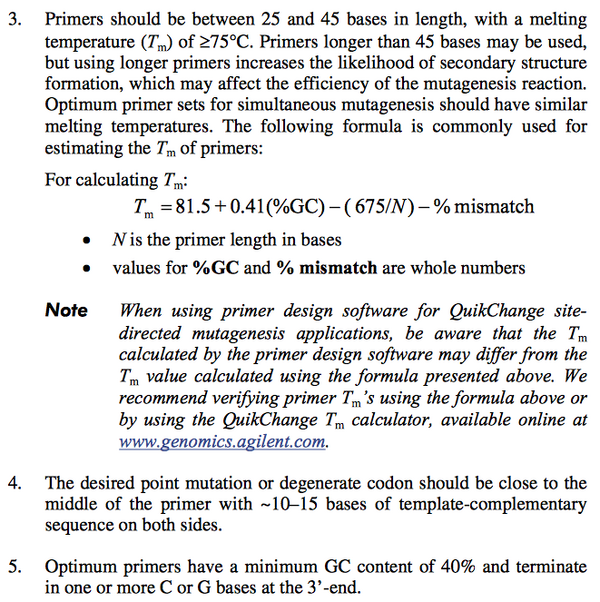
* Use guidelines in the manual:
** [[image:Quik_change_lightning_multi_kit_primer_instructions.jpg|thumb|upright=2.0|center|primer design instructions from the [http://www.chem.agilent.com/library/usermanuals/Public/210514.pdf manual]]]
** [[image:Quik_change_lightning_NOT-multi_kit_reaction_recipe.jpg|thumb|upright=3.3|center|reaction recipe instructions from the [http://www.chem.agilent.com/library/usermanuals/Public/200523.pdf non-multi Lightning manual]]]
* '''Lightning Multi''':
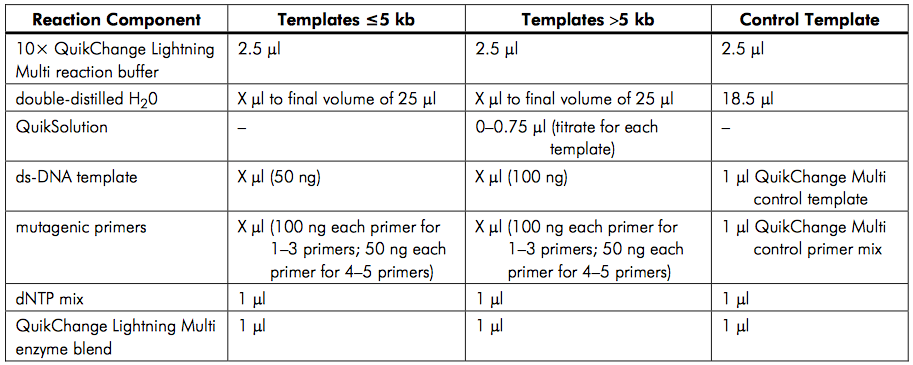
** [[image:Quik_change_lightning_multi_kit_reaction_recipe.jpg|thumb|upright=3.3|center|reaction recipe instructions from the [http://www.chem.agilent.com/library/usermanuals/Public/210513.pdf Lightning manual]]]
** QuikSolution (DMSO) can be added: 0 - 0.75uL per 25uL of reaction.
** ds-DNA template = 50ng per 25uL for <5 kb, or 100 ng per 25uL if for >5 kb.
*** 2ng/uL works fine for 6kb plasmids. -'''[[User:Janet Matsen|Janet Matsen 9/2014]]'''
** primers:
*** our lab usually dilutes primers to 10uM, and the recipes are for ng. Usually 10uM is ~100ng/uL.
*** Add ~0.5uL of primer per 8uL of reaction. *'''[[User:Janet Matsen|Janet Matsen 9/2014]]'''
== Thermocycling ==
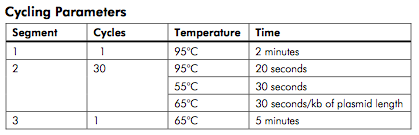
*'''Regular LIGHTNING Kit''' (but not multi LIGHTNING kit)
** [[image:Quik_change_lightning_NOT_multi_kit_thermocycling.jpg|thumb|upright=3.3|center|thermocycling protocol from [http://www.chem.agilent.com/library/usermanuals/Public/210518.pdf NOT-multi manual]]]
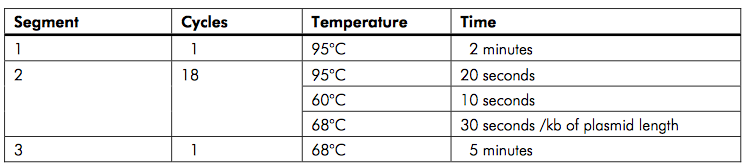
*'''Multi Lightning Kit'''
** [[image:Quik_change_lightning_multi_kit_thermocycling.jpg|thumb|upright=3.3|center|thermocycling protocol from [http://www.chem.agilent.com/library/usermanuals/Public/210513.pdf Multi + Lightning manual]]]
== Tips ==
== Tips ==
* Though the lightning Dpn1 enzyme claims to be effective in 5 minutes, you might as well incubate it for 30 minutes, just in case it lowers your unmutated background further.
* Though the lightning Dpn1 enzyme claims to be effective in 5 minutes, you might as well incubate it for 30 minutes, just in case it lowers your unmutated background further.
* If you want to use one priming site to introduce mutations, it is about the same price to order 1 oligo and do it with the multi kit, or order 1 pair of complementary oligos and do it with the non-multi kit. If ordering less primers is appealing, go for it. A small decrease in efficiency might be seen, but it shouldn't be a problem based on *'''[[User:Janet B. Matsen|Janet Matsen]] 10:29, 12 June 2014 (EDT)''':
* If you want to use one priming site to introduce mutations, it is about the same price to order 1 oligo and do it with the multi kit, or order 1 pair of complementary oligos and do it with the non-multi kit. If ordering less primers is appealing, go for it. A small decrease in efficiency might be seen, but it shouldn't be a problem based on [[User:Janet B. Matsen|JM's]] use of one primer to introduce 24 different mutations. (The first colony screened had the desired mutation in 90+% of the sequenced plasmids and the efficiency was quite high.)
* From the manual:
** Thaw the dNTP mix once, prepare single-use aliquots, and store the aliquots at –20°C. Do not subject the dNTP mix to multiple freeze-thaw cycles
* Make your kit last longer by doing 8uL reactions, not 25uL. You only transform 1uL per reaction so this is always plenty.
The marketing term "lightning" refers to an improved Dpn1, that degrades template (unmutated template) more efficiently.
If you buy the kits, 10uL rxns are plenty (this is ~4x less than the protocol suggests) and transformations using 10uL of competent cells are suitable. If you are introducing mutations with multiple priming sites, you could consider transforming more.
Quik Solution
Quik Solution is probably pure DMSO.
Two (main) QuikChange kits are available
QuikChange Lightning.
For mutations contained within a single primer
QuikChange Lightning Multi
For mutations contained in >1 primer
Can be used for mutations contained in 1 primer, but this kit is more expensive than the single kit and likely has lower efficiency.
Both kits:
come with chemically competent XL10-Gold. This is perhaps the most valuable part of the kit.
Though the lightning Dpn1 enzyme claims to be effective in 5 minutes, you might as well incubate it for 30 minutes, just in case it lowers your unmutated background further.
If you want to use one priming site to introduce mutations, it is about the same price to order 1 oligo and do it with the multi kit, or order 1 pair of complementary oligos and do it with the non-multi kit. If ordering less primers is appealing, go for it. A small decrease in efficiency might be seen, but it shouldn't be a problem based on JM's use of one primer to introduce 24 different mutations. (The first colony screened had the desired mutation in 90+% of the sequenced plasmids and the efficiency was quite high.)
From the manual:
Thaw the dNTP mix once, prepare single-use aliquots, and store the aliquots at –20°C. Do not subject the dNTP mix to multiple freeze-thaw cycles
Make your kit last longer by doing 8uL reactions, not 25uL. You only transform 1uL per reaction so this is always plenty.