Biomod/2015/Tianjin/Project
<html> <style type="text/css"> /**** Base styles ****/ /*#column-one, */
- footer, div#sidebar-main, #contentSub, .firstHeading, #siteSub, #jump-to-nav, .printfooter, #p-cactions {
display: none;
}
/*only show edit button - also remove p-cactions from previous style*/
- ca-nstab-main, #ca-talk, #ca-history, #ca-move, #ca-watch, #ca-link, #p-personal{
display: none;
}
- ca-edit{
display:block;
} /*Make text on edit buttons visible for easier editing*/ .editButtons, #wpSummary{ color: black; }
</style> <style type="text/css">
#contentSub, #footer-box, #catlinks, #search-controls, #p-logo, .printfooter, .firstHeading, .visualClear { display: none; }
#top-section { border: 0 none; height: 14px; z-index: 100; top: 0; position: fixed; width: 975px; left: 50%; margin-left: -487px; }
#globalWrapper, #content { width: 100%; height: 100%; border: 0px; background-color: transparent; margin: 0px; padding: 0px; font-size: 100%; }
html, body, .wrapper { width: 100%; height: 100%; background-color: transparent; }
.navbar { margin: 0 auto; margin-top: 1em; padding: 1em; border-radius: 10px; }
</style>
<style type="text/css">
- {margin-bottom: 0px;margin-left: 0px;margin-right: 0px;margin-top: 0px;}
- backcontain{width:100%;height:auto;background-color:#3CF;}
- contain{width:1100px;background-color:#FFF;height:auto;margin-left:auto;margin-right:auto; box-shadow: 0px 5px 8px rgba(0,0,0,0.4);}
- header{width:1100px;margin-left:auto;margin-right:auto;text-align:right;float:left;margin-top:10px;background-image:url(http://openwetware.org/images/4/41/Home3.png);height:300px;box-shadow: 0px 5px 8px rgba(0,0,0,0.4);}
.menu ul {margin-top:250px;list-style:none;} .menu a {text-decoration:none;color:#480002} .menu ul li { height: 50px; background-color: transparent; float:right; text-align:right; font-family: Verdana, sans-serif; font-size: 24px; line-height: 50px; background-position: 100% 0%; margin-right:40px; } /*For the menu buttons, changes the color when hovering*/ .menu ul :hover { color: #F00; } .menu li:hover {color: #F00;border-bottom: 5px outset #FF0000;} /*Submenus are not displayed as default*/ .menu li ul {display: none;} /*Submenus are displayed when hovering the menu button */ .menu li:hover ul {display: block; position: absolute;margin-left:-150px;margin-top:5px;float:right;} /*Style the submenu buttons*/ .menu li ul li{background-color:transparent;float:left;text-align:center;font-family: Verdana, sans-serif;font-style: normal;font-weight: lighter;font-size:18px;line-height: 25px; margin-top:0px;color:#003;width:auto} .menu li ul li:hover {color: #F00;border-bottom:hidden;}
- parta{
width: 600px; font-family: Arial; margin-top: 10px; line-height: 35px; float: left; padding-left: 15px; padding-right: 10px; text-align: justify; }
- partb{
width:620px; font-family: Arial; margin-top: 30px; line-height: 35px; margin-left:15px;padding-top:10px; padding-left: 10px; padding-right: 10px; color:#900; text-align: justify; float: left; }
- partc{
width: 1070px;height:auto font-family: Arial; margin-top: 20px; line-height: 35px; padding-left: 15px; padding-right: 15px; padding-bottom:20px; padding-top:0px; text-align:justify; float: left; }
- tabletable{
width: 1070px;height:auto font-family: Arial; margin-top: 0px; line-height: 20px;font-size:16px; padding-left: 15px; padding-right: 15px; padding-bottom:20px; padding-top:0px; text-align:justify; float: left; }
h1{
font-size: 23px;
text-align:left;
font-weight: bold;color:#900;font-family: Arial;
}
p{ font-size: 20px; text-align: justify;font-family: Arial; }
- foot{
height: 80px; background-color: #333; float: left; margin-left:auto;margin-right:auto; width:1100px;padding-top:5px; font-family: Arial, sans-serif; font-size:15px;line-height: 25px; color: rgba(255,255,255,1); text-align: center;} .table1{font-family:Arial;width:90%;border-collapse:collapse;margin-left:5%} .table1 td, .table1 th{font-size:17px;border:1px solid #ccc;padding:5px 10px 5px 10px;width:150px;} .table1 th {font-size:17px;text-align:left;padding-top:5px;padding-bottom:4px;background-color:#ccc;color:#ffffff;} .table1 tr.alt td {color:#000000;background-color: #fafafa;font-size:16px}
</style> <style type="text/css">
- banner { padding: 0px; width:430; float:left;margin-top:0px;}
.slides { margin-left:auto;margin-right:auto; width: 100%; overflow: hidden; position: relative; } .slide-pic { margin-left:auto;margin-right:auto;padding:0px; width: 100%; overflow: hidden; list-style: none; } .slide-pic img { width: 100%; } .slide-pic li { display: none; } .slide-pic li.cur { display: block; } .slide-li {padding: 0px; right: 50px; bottom: 0px; position: absolute;float:left;} .slide-li li { margin: 0px; padding: 0px; width: 30px; height:20px ;float:left;overflow: hidden;} .slide-li a { width: 30px; height: 20px; color: #000; font-size: 20px; display: block; text-align:center;text-decoration:none;margin-bottom:5px;} .slide-li a:hover { color: #ccc; text-decoration: none; } .slide-txt span { display: none; } </style> <script src="Scripts/swfobject_modified.js" type="text/javascript"></script> <script type="text/javascript"> jQuery(function ($) {
   if ($(".slide-pic").length > 0) {
       var defaultOpts = { interval: 5000, fadeInTime: 300, fadeOutTime: 200 };
       var _titles = $("ul.slide-txt li");
       var _titles_bg = $("ul.op li");
       var _bodies = $("ul.slide-pic li");
       var _count = _titles.length;
       var _current = 0;
       var _intervalID = null;
       var stop = function () { window.clearInterval(_intervalID); };
       var slide = function (opts) {
           if (opts) {
               _current = opts.current || 0;
           } else {
               _current = (_current >= (_count - 1)) ? 0 : (++_current);
           };
           _bodies.filter(":visible").fadeOut(defaultOpts.fadeOutTime, function () {
               _bodies.eq(_current).fadeIn(defaultOpts.fadeInTime);
               _bodies.removeClass("cur").eq(_current).addClass("cur");
           });
           _titles.removeClass("cur").eq(_current).addClass("cur");
           _titles_bg.removeClass("cur").eq(_current).addClass("cur");
       };
       var go = function () {
           stop();
           _intervalID = window.setInterval(function () { slide(); }, defaultOpts.interval);
       };
       var itemMouseOver = function (target, items) {
           stop();
           var i = $.inArray(target, items);
           slide({ current: i });
       };
       _titles.hover(function () { if ($(this).attr('class') != 'cur') { itemMouseOver(this, _titles); } else { stop(); } }, go);
       _bodies.hover(stop, go);
       go();
   }
}); </script>
<style type="text/css"> .icon{float:left;} .icon img{width:190px;height:190px;} </style> <style type="text/css">
- apDiv10 {
position:relative;
float:left;margin-top:30px;margin-left:20px;
display:block;
width:380px; z-index:3;
box-shadow: 0px 5px 8px rgba(0,0,0,0.4);
text-align: left; font-family:Arial; font-size: 18px; line-height:28px; color: #000; background-color: #ffffff;
        padding:20px;
        }
.toclevel-1 a {text-decoration:none;color:#000} .toclevel-1 a:hover{color:#F00;} .kuang{z-index:3;box-shadow: 0px 5px 8px rgba(0,0,0,0.4); margin-left:auto;margin-right:auto;padding-left:10px;padding-right:10px;} </style>
Contents
|
<script type="text/javascript"> if (window.showTocToggle) { var tocShowText = "show"; var tocHideText = "hide"; showTocToggle(); } </script>
We design and construct artificial intelligent cell (A.I. cell) with microfluidic droplets. Our A.I. cells demonstrate morphological and functional mimics of mammalian cells. In detail, the shape and size of microfluidic droplets resemble mammalian cells; and the central biochemical reactions of cells, i.e., transcription and translation, function well in our A.I. cells.
1. Fabrication of microfluidic device
Microfluidics has recently emerged as a robust platform for the formation of microdroplets. Monodisperse aqueous droplets in oil are formed and manipulated with microfluidic device. These droplets are in the nL-pL range and can be considered as completely isolated reaction chambers. Microdroplets can be generated at rates in excess of thousands per second. The power of microfluidics to prepare droplets lies in the formation of uniform droplets, fine control of the shape, size and monodispersity.
First we designed microfluidic patterns using AutoCAD and fabricated masters with patterns on silicon wafer in clean room. Afterwards, we used elastomeric polymer, Polydimethylsiloxane (PDMS), as stamps to replicate the patterns on master, known as soft lithography technology. Before sealing PDMS pad with microfluidic channels on class slides, we punched holes at the inlets and outlets of the channels.
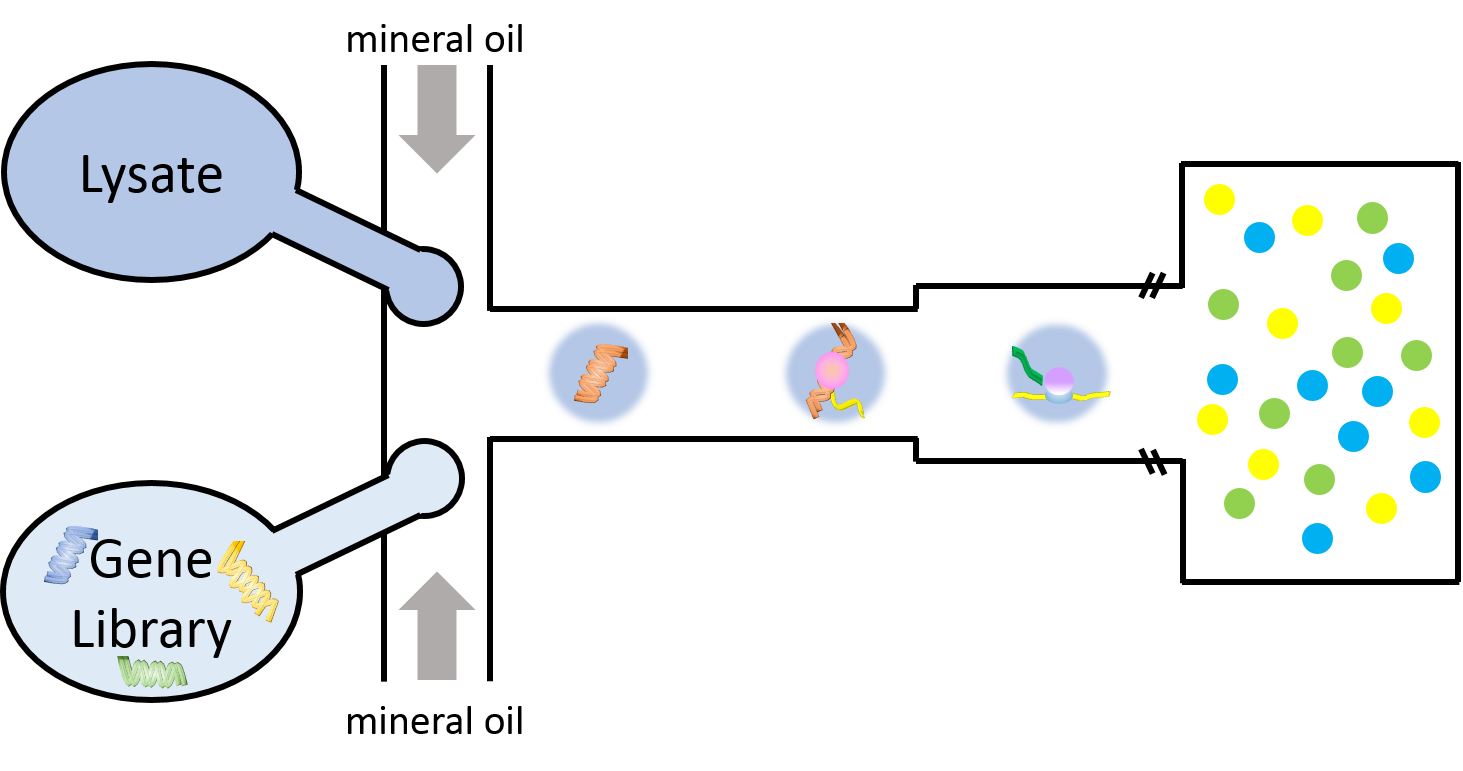
To prepared droplets, we designed flow focusing patterns. Mineral oil was the continuous phase. Syringe pumps were employed to control the fluid speed of aqueous and oil phases. Through tuning the fluid speeds, surfactant concentration in oil, we obtained stable droplets with excellent monodispersity.
<a href="http://openwetware.org/images/d/d2/%E5%B9%BB%E7%81%AF%E7%89%876.PNG" target="_blank" ><img src= "http://openwetware.org/images/d/d2/%E5%B9%BB%E7%81%AF%E7%89%876.PNG" width="660" alt=""/></a>
Figure 1. Fabrication of microfluidic device<a href="http://openwetware.org/images/d/d2/%E5%B9%BB%E7%81%AF%E7%89%876.PNG" target="_blank"><img src="http://2013.igem.org/wiki/images/9/90/Enlarge.jpg" width="20" height="20" align="right" alt="" /></a>
<a name=" Design and construction of in vitro transcription and translation (IVTT)" id=" Design and construction of in vitro transcription and translation (IVTT)"></a>
2. Design and construction of in vitro transcription and translation (IVTT)
Transcription and translation are the central biochemical reactions in living systems, which are universally preserved in all life formats, such as in modern cells. Therefore, in vitro transcription and translation (IVTT) provides a powerful experimental model for exploring events in our A.I. cells.
In IVTT system, the plasmid DNA encoded with functional genes was designed and constructed first; with incubation with cell lysates, DNA was transcribed to RNA, which was afterwards translated to proteins. Our IVTT contains two parts: cell lysates and plasmid DNA.
<a href="http://openwetware.org/images/6/68/Construction_of_IVTT_system.png" target="_blank" ><img src= "http://openwetware.org/images/6/68/Construction_of_IVTT_system.png" width="480" alt=""/></a>
Figure 2. Construction of IVTT system<a href="http://openwetware.org/images/6/68/Construction_of_IVTT_system.png" target="_blank"><img src="http://2013.igem.org/wiki/images/9/90/Enlarge.jpg" width="20" height="20" align="right" alt="" /></a>
<a href="http://openwetware.org/images/2/23/%E5%B9%BB%E7%81%AF%E7%89%874.PNG" target="_blank" ><img src= "http://openwetware.org/images/2/23/%E5%B9%BB%E7%81%AF%E7%89%874.PNG" width="660" alt=""/></a>
Figure 3. Kinetic curve of GFP expressed in IVTT <a href="http://openwetware.org/images/2/23/%E5%B9%BB%E7%81%AF%E7%89%874.PNG" target="_blank"><img src="http://2013.igem.org/wiki/images/9/90/Enlarge.jpg" width="20" height="20" align="right" alt="" /></a>
<a name="Design and construction of DNA molecules" id="Design and construction of DNA molecules"></a>
3. Design and construction of DNA molecules
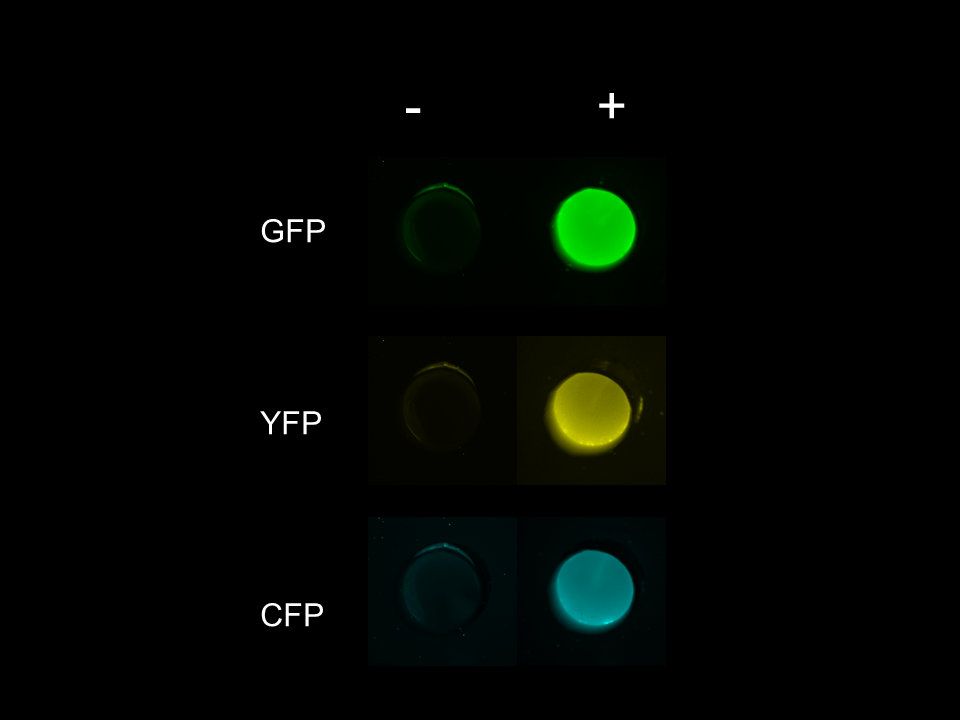
We varied the sequences of reporter genes in pRSET vector and got different plasmids, including pRSET-GFP, pRSET-YFP and pRSET-CFP. With incubation those plasmids with cell lysate, accordingly we produced GFP, YFP and CFP in IVTT.
<a href="http://openwetware.org/images/3/31/%E5%B9%BB%E7%81%AF%E7%89%877.PNG" target="_blank" ><img src= "http://openwetware.org/images/3/31/%E5%B9%BB%E7%81%AF%E7%89%877.PNG" width="480" alt=""/></a>
Figure 4. Rational design of DNA molecular<a href="http://openwetware.org/images/3/31/%E5%B9%BB%E7%81%AF%E7%89%877.PNG" target="_blank"><img src="http://2013.igem.org/wiki/images/9/90/Enlarge.jpg" width="20" height="20" align="right" alt="" /></a>
<a name="Design and construction of A.I. cells" id="Design and construction of A.I. cells"></a>
4. Design and construction of A.I. cells
We used the microfluidic device to prepare microdroplets, with encapsulation of IVTT in droplets, generating A.I. cells. To obtain stable A.I. cells with fine monodispersity, we optimized the dimension of microfluidic channels, the flow rate of cell lysate and oil phase, as well as the concentration of surfactant in oil.
To avoid IVTT reactions during the formation of A.I. cells, we controlled the temperature at 4 °C, afterwards incubated A.I. cells at 37 °C to initiate the reactions.
<a href="http://openwetware.org/images/3/37/Construction.png" target="_blank" ><img src= "http://openwetware.org/images/3/37/Construction.png" width="660" alt=""/></a>
Figure 5. Construction of artificial cells<a href="http://openwetware.org/images/3/37/Construction.png" target="_blank"><img src="http://2013.igem.org/wiki/images/9/90/Enlarge.jpg" width="20" height="20" align="right" alt="" /></a>
<a href="http://openwetware.org/images/3/3a/Huandengpianq.png" target="_blank" ><img src= "http://openwetware.org/images/3/3a/Huandengpianq.png" width="660" alt=""/></a>
Figure 6. Different fluorescent proteins expressed in IVTT using 96-well plates <a href="http://openwetware.org/images/3/3a/Huandengpianq.png" target="_blank"><img src="http://2013.igem.org/wiki/images/9/90/Enlarge.jpg" width="20" height="20" align="right" alt="" /></a>
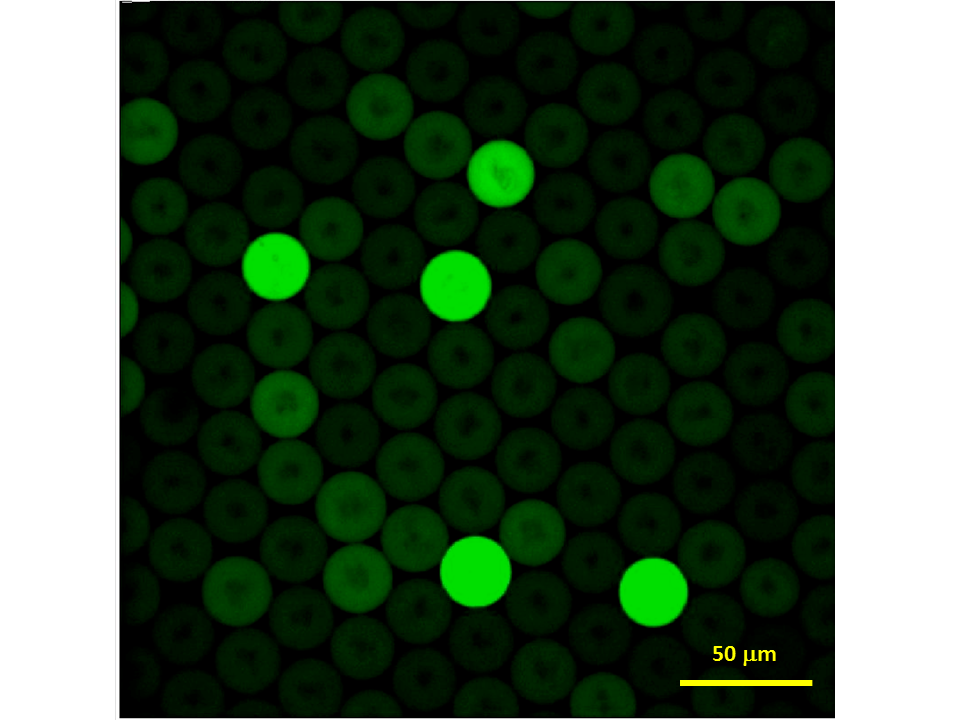
<a href="http://openwetware.org/images/1/10/%E5%B9%BB%E7%81%AF%E7%89%8712.PNG" target="_blank" ><img src= "http://openwetware.org/images/1/10/%E5%B9%BB%E7%81%AF%E7%89%8712.PNG" width="660" alt=""/></a>
Figure 7. Artificial cells with or without GFP gene under the same condition(the bright green Artificial cells are cells with GFP gene and the dark green cells are not). <a href="http://openwetware.org/images/1/10/%E5%B9%BB%E7%81%AF%E7%89%8712.PNG" target="_blank"><img src="http://2013.igem.org/wiki/images/9/90/Enlarge.jpg" width="20" height="20" align="right" alt="" /></a>
     E-mail: ggjyliuyue@gmail.com |Address: Building No.20, No.92 Weijin road, Tianjin University, China | Zip-cod: 300072

     Copyright 2015@Tianjin Biomod Team
</html>


;height:300px;box-shadow)