User:Jakob G. Wells: Difference between revisions
No edit summary |
No edit summary |
||
| Line 8: | Line 8: | ||
*[[Special:Emailuser/Jakob G. Wells|Email me]] | *[[Special:Emailuser/Jakob G. Wells|Email me]] | ||
I work in the | I work in the Speedie and Associates lab at Speedie and Associates. | ||
==Education== | ==Education== | ||
Revision as of 14:07, 8 November 2012
Contact Info

- Jakob G. Wells
- Arizona State University
- 500 East University Drive
- Tempe, Arizona, United States
- Email me
I work in the Speedie and Associates lab at Speedie and Associates.
Education
- Currently seeking a Bachelors in Science and Engineering at Arizona State University
Research interests
Research and Development
Specific Cancer Marker Detection - The Underlying Technology
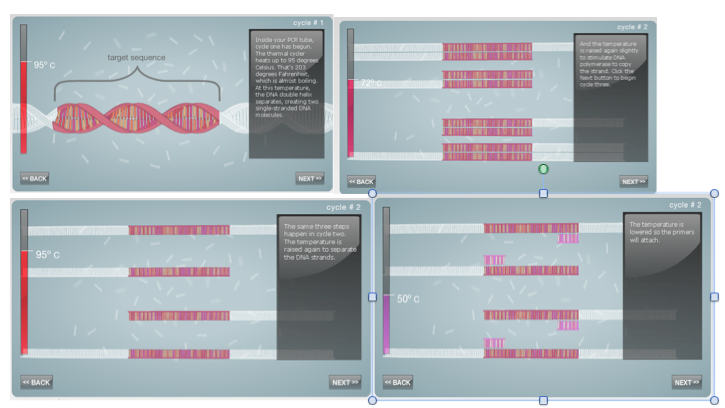
PCR detection works by heating the DNA sample to about 110°C in order to split the DNA. Then the PCR cools off to 57°C in order for the primer to attach to the DNA strands. The PCR then heats to 72°C so the DNA strand can be re-written. The r17879961 cancer-associated sequence will produce a DNA signal because the reverse primer used, AACTCTTACACTCGATACAT will only attach if the DNA sample has the same coding with the cancer-associated sequence “ACT”. If the DNA sample does not have the cancer-associated sequence the primer will not attach and there will be no DNA signal.
http://openwetware.org/images/3/39/Screen_Shot_2012-11-01_at_3.56.31_PM.png
Source: http://openpcr.org/use-it/
- Interest 2
- Interest 3
Publications
- Goldbeter A and Koshland DE Jr. An amplified sensitivity arising from covalent modification in biological systems. Proc Natl Acad Sci U S A. 1981 Nov;78(11):6840-4. DOI:10.1073/pnas.78.11.6840 |
- JACOB F and MONOD J. Genetic regulatory mechanisms in the synthesis of proteins. J Mol Biol. 1961 Jun;3:318-56. DOI:10.1016/s0022-2836(61)80072-7 |
leave a comment about a paper here
- ISBN:0879697164